Do Your Customers Actually Want Personalization?


Earlier this week, we looked at one of email marketing's finest achievements:
Hi {{first_name}}
Personalization that failed so badly it exposed the machinery behind the email. But there’s another personalization mistake that’s harder to spot.
The merge tag works, the data is accurate, the automation fires perfectly… but the email still feels wrong.
Because sometimes the problem isn’t how you personalized the email, it’s that you personalized it in the first place.
Marketers are constantly told to personalize, to use their name, reference their behaviour, recommend products based on what they viewed, and so on and so on.
There are plenty of situations where that stuff is useful, but personalization isn’t automatically good customer experience.
There’s another question we should be asking:
Does this customer actually want this level of personalization?
Because there’s a fine line between “That’s useful” and “Wait… how much do these people know about me?”
From The Lab
Here’s this week’s rule:
Personalization should create relevance, not surveillance.
Knowing something about a customer doesn’t automatically mean you should put it in an email.
Before using customer data, think about the context in which that information was provided, what the customer would reasonably expect you to do with it, and whether surfacing it actually improves the message.
Take their first names. If someone deliberately gives you their name when creating an account, using it occasionally may feel completely natural.
But what if your signup form only asks for an email address? What if a large portion of your audience never provides their name?
Then don’t design an email program that depends on knowing everyone’s name.
You don’t need to turn:
You order is on the way.
into:
Bob, your order is on the way.
just so you can say the email was personalized. The first version already does its job.
Know Your Industry
This is where personalization gets much more interesting.
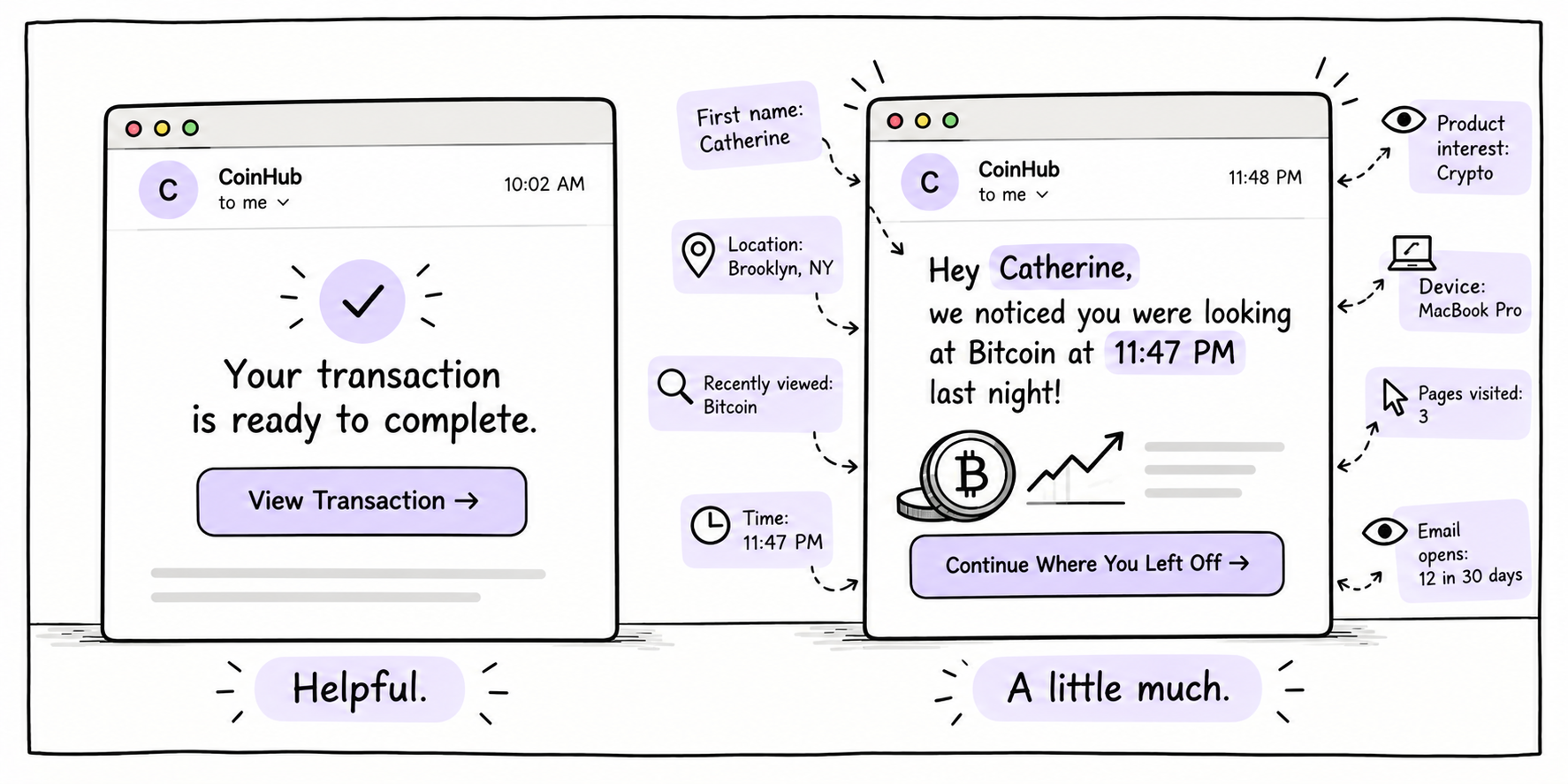
I’ve worked in crypto, where customer expectations can be very different from something like retail. Some crypto users place a particularly high value on privacy and anonymity.
Imagine receiving:
Hey Catherine, we noticed you were looking at Bitcoin at 11:47 PM last night!
Even if every piece of data in that sentence is accurate, you may have just created a new question: Why are you tracking that?
And suddenly the email isn’t about Bitcoin anymore, it’s about how much the company knows about you.
Compare that with: Your transaction is ready to complete.
Same customer, same journey, still relevant.
But we’re using the information necessary to help the customer instead of demonstrating everything we happen to know about them.
That’s an important distinction. Different industries will have different expectations around personalization.
It all boils down to understanding the customer.
The Personalization Test
Before adding a personalized field or behavioural trigger to an email, ask:
- Do we reliable have this data? If half your database doesn’t have a first name, don’t build the experience around one.
- Would the customer expect us to have this information? An order number from something they just purchased? Probably. A behavioural detail they didn’t realize you were collecting? Think harder.
- Would they expect us to use it here? Having data and surfacing data are two different things.
- Does it make the email more useful? If removing the personalization changes nothing, you probably don’t need it.
- Could it make the customer uncomfortable? Consider the industry, audience, sensitivity of the information and context.
- What happens when the data isn’t there? Always test the fallback.
The Mini Experiment
Open one of your automated emails that uses personalization (make a duplicate, silly).
Now remove every personalized field. First name, company, location, behavioural references, product recommendations, whatever else you’ve added.
Read the email again, then add personalization back one piece at a time.
For each one, ask yourself: Does knowing this make the email more useful to the customer?
If yes, keep it! If it only makes the email look personalized, question whether you need it. This is especially useful for first-name greetings.
You might discover that:
Jackie, here’s what’s new this week.
isn’t meaningfully better than:
Here’s what’s new this week.
And now you’ve removed a data dependency without sacrificing anything.
Takeaway
Most personalization does not automatically mean better email marketing. The best personalization isn’t necessarily the most personal. It’s the most useful.
Understand the audience you’re talking to.
Understand what information they’ve given you.
Understand what they expect you to do with it.
And remember: Personalization should create relevance, not surveillance.
If your customer finishes reading the email thinking about how much you know about them instead of what you wanted them to do next, you’ve probably gone too far.
Want a second set of eyes on your emails?
Plotnicki helps teams fix broken campaigns, lifecycle gaps, newsletters and email systems that should be working harder.
Reply to this email or click the link below so we can take a look.